mardi 23 février 2016

Japan Kebari: Masami "Tenkara-no Oni" Sakakibara

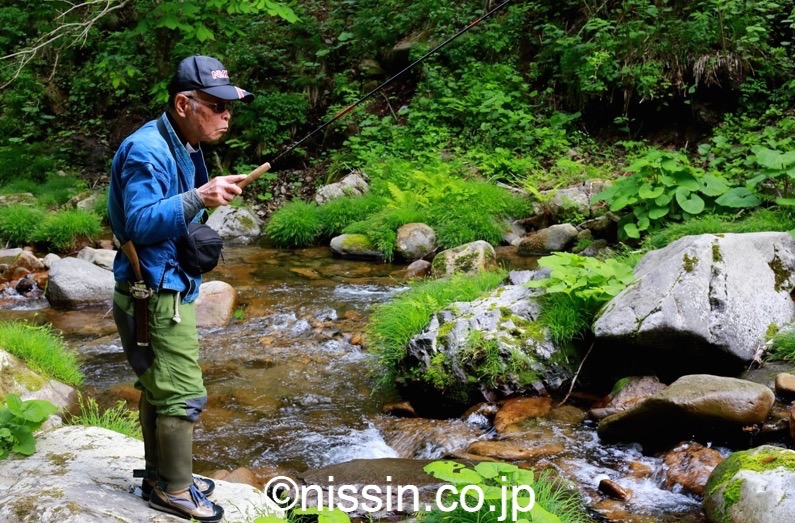
It is rare to have the opportunity to meet the people who inspire us and thanks to whom we have developed a passion for something but I am gifted to have the pleasure to go fishing with the man who made me discover tenkara: Masami Sakakibara. 


With his thirty five years experience in the field of tenkara Masami Sakakibara's style is the perfect illustration of the highest skilled master. Faithful to the basic principle of tenkara "A rod, a line, a fly"
he has developed his technique instead of carrying a lot of tackle. Oni tenkara is not only simple but also very efficient and it is explicit when one sees his kebari and thinks a little about it. I think that the Tenkara-no Oni style of fly tying can be resumed by a simple motto: "design matches function".


This kebari tied by Masami-san is probably his most famous pattern. He is used to name his patterns from the materials used, in this case "Oni black pheasant kebari". What has in first place made this kebari famous among western tenkara anglers is its size as Masami-san ties it on hooks up to size 2. But function dictates design and size and this kebari is designed to be used in the sasoi technique.


Masami-san uses Tiemco "pellet dubbing", which is a natural substitute for seal fur, for the body of this kebari; a hen pheasant feather on a Gamakatsu S10 hook.
The next kebari is Masami-san's interpretation of a Mayfly, a huge ephemera, it is realistic by its size but impressionistic by its design.  I think that this describes very well Tenkara-no Oni style of fly-tying.


The body is made of polypropylene yarn and that is a good product if one wants low floatation kebari. The hackle will give the illusion of life to this kebari when on the water surface. 


If fishing big streams with long level lines has become a kind of hallmark of Tenkara-no Oni style he is also a very experienced and skilled small streams tenkara angler as I got to realize during my stay with the Team Oni in the mountains. 


To fish in shallow mountain streams small sized , in relation with the observable small insects, and light kebari are needed to obtain natural drifts. Masami-san is accosumated to tie his small sized kebari on Tiemco 2499-SP BL hooks that as he says have great features for small streams tenkara fishing: short shank, wide gap and laser sharp point. 


Masami Sakakibara's experience shows that it is possible to practice successful tenkara fishing on any water with his "simple" kebari because he has developed his technique on rational analysis of his fishing and fish behavior. 


Masami-san has developed over the years a tenkara fishing system that is not only simple but also very effective. I would even personally say that the Oni tenkara style has become so effective because it has been kept simple throughout the years. While fishing with him in the mountains I understood why his nickname is "Tenkara-no Oni", the Tenkara demon. As he says himself: "A tenkara angler must be one with the stream". 


If you want to learn more about Masami Sakakibara and the Oni tenkara style I invite you to check his awesome blog. 


dimanche 7 février 2016

Japan Kebari: Kazumi "Ajari" Saigo


After a little more than a couple of years of social network friendship I had the  pleasure during my stay in Japan to meet a friend who is as passionate as I am about tenkara: Kazumi "Ajari" Saigo.
During the hours of drive we did together from Kyoto to the banks of the Shō-gawa we talked about everything tenkara and I realized that my host's long experience with Masami Sakakibara and Dr. Hisao Ishigaki had gone to his head and that on the contrary he was happy to share his favorite streams with foreign tenkara anglers. 
Kazumi Saigo who was a bass competition angler at the highest level has been seduced by the simplicity and efficiency of tenkara and that shows in his ability to give one the best advices while doing countless jokes. 


Ajari uses a very small number of kebari and these are very simple. Like other Japanese tenkara anglers he does not give names to his kebari. Over the years he refined his technique and his ties are now the same size 14 which is the one giving the best results on the streams he is used to fish. 


The one above is tied on a size 14 Tiemco 403 BLJ hook which is commonly called "jig hook" by fly tiers. The value of this hook is to give a more natural "swim" to the kebari, or rather moves closer to the swimming of a real insect trying to head for the surface. The body of this kebari is made of Hareline "Ice Dub" dubbing that is an excellent synthetic product that does not soak up water and is very durable. Ajari also uses the "Ice Dub" in black which is an interesting substitute for peacock herls.


The benefit of this synthetic dubbing is obviously not to be more attractive to fishes, especially salmonids because as scientific studies show their eyes are not sensitive to UV longer than in the first weeks of their lives, but to be stronger than natural peacock herls.


This second model is tied on a Tiemco 2487 BL hook size 14. The body made of natural peacock herls and its collar black cock hackle make it an extremely versatile pattern that can suggest for a fish hundreds of insect species which are its usual food.
Having had the opportunity to observe Ajari fishing I can state that he masters the drift of his kebari perfectly as he has understood long ago that it was the key of successful tenkara fishing: the fish do not make the difference between a true insect and a kebari if it drifts to the good speed. Rather than multiplying the kebari models Ajari has adapted his technique to fish behavior.


There is no doubt that in the future this excellent and friendly tenkara angler gains a lot of attention from the tenkara community. A fisherman who has developed a very effective technique while remaining faithful to the principle of simplicity of tenkara and who likes sharing will undoubtedly become a respected ambassador of tenkara.

mercredi 20 janvier 2016

Japan Kebari: Hirata-san

When I arrived in Gifu Prefecture I went with my guests in a small fishing gear shop located a few steps from the Itoshiro river held by Hirata-san. Located a few steps from the river this little shop is the place to stay in the region to be informed of the fishing conditions in the area and buy what you need.
In many ways the Hirata-san shop reminded me of those still existing  fifteen years ago in my area and that were held by true fishing junkies and where we were going to buy as much as our material for the simple pleasure to discuss. Hirata-san's tackle shop is exactly that kind of shop. 


If Hirata-san's shop is small it offers no less than anything you need to practice ayu, esa zuri and tenkara. The latest gear rubs beautiful tamos manufactured by the master of the house and bamboo tenkara rods.
I did take advantage also of Hirata-san advices to purchase some spools of fluorocarbon tippet then I became interested in the contents of two wooden boxes placed on the counter of the shop. One of them contained the famous "mamushi kebari".


This kebari really deserves to be described as "one of a kind" as Hirata-san uses the skin of gloydius blomhoffii, a highly venomous viper which is called "mamushi" in Japan. Having met several of these snakes when I was in the mountains around Tadami I can assure you that the behavior of this snake is typically that of a viper: it does not flee at your approach, quite the contrary.


Hirata-san uses the skin of this venomous snake to make the body of its kebari. To people who tell him that they are too expensive kebari, around USD 8.50 each, he replies with a smile: "I risk my life to tie these kebari!"
Hirata-san is used to tie his kebari with a pair scissors as sole tool and the result is nonetheless very successful, that is the evidence of a long experience of tool-free tying.


But Hirata-san's kebari are not only beautiful, they are also very strong as he uses nail varnish as a glue. Hirata-san uses  Owner Kuwahara Tenkara hooks.
The second box on the counter of the shop contained other kebari tied by Hirata-san. He of course also ties them without tools on the same hooks but with embroidery thread as a body. When I visited all of them had a beige body but differed in the colors of their hackles ranging from grizzly to black through  furnace brown.


Hirata-san also finishes these kebari by a thin layer of nail varnish on the body to make it more durable. As he stated varnish body does not change in appearance when the kebari has been submerged.  Like most of the tenkara anglers I did meet in Japan Hirata-san has  observed long ago that  it is not the kebari that catches fish but the angler who knows how to use it wisely. 


dimanche 3 janvier 2016

Japan Kebari: Dr. Hisao Ishigaki

During my stay in Japan I was lucky thanks to the intervention of my friend Kazumi Saigo of Dr. Hisao Ishigaki meet with whom I did fish an afternoon on the legendary Itosihro. It was of course a very good experience and a joy to meet one of the most notable ambassadors of tenkara.
Ishigaki-sensei and I exchanged some of our kebari after fishing.


We all know the Ishigaki sakasa kebari and most of us have tied this pattern in their tenkara beginnings but the original tied by Ishigaki Sensei are very different from western versions  which in most cases show excessive attention to details.
The tenkara technique of Dr Hisao Ishigaki is based on a rational observation of salmonid behavior, especially their sense of vision.


If the details in the pattern may be important for the fisherman they have none for fish which, because of the quasi-spherical and rigid lens of their eyes are myopic. 
Made of tying thread and a cock hackle feather a tenkara angler who considers his technique more important to meet success than the choice of a particular pattern will use this kebari as a dry, an emergent or a wet fly. When Ishigaki sensei opened his box to give me some of his kebari he took two other models that have no name.


Both kebari are tied on Varivas barbless hooks, they are of great simplicity and flawlessly efficient in fishing. The movements of their hackle on and under the water surface is certainly no stranger to their efficiency.


Ishigaki Sensei has developed a downstream wet fly fishing technique called "Tomezuri". This technique is very effective and allows successful downstream fishing at short distance. I was initiated by Ishigaki sensei himself and I can state that these kebari tied with long supple hackles perfectly work. Not only in Japanese mountain streams but on any stream.


As the masters of tenkara Ishigaki sensei has demonstrated during his career that while remaining faithful to the principle of simplicity of tenkara he was able to develop a range of effective techniques based on rational observation of salmonids.

John and Paul of Discover Tenkara have released an excellent video starring Ishigaki sensei that you can watch by clicking here.
Learn more about Ishigaki sensei and his tenkara experience in the very interesting interview he did with Adam and that was published on the Tenkara Fisher forum. 

dimanche 13 décembre 2015

Japan Kebari: Hiromichi Fuji

Last July during my stay in Japan I had the opportunity and the privilege of meeting a key figure of the history of modern tenkara: Hiromichi Fuji.
He was one of the first angler to use  tenkara as sport fishing and not a commercial technique and has played a central role in the design of modern tenkara rods and lines. During the afternoon I spent in his workshop we did tie some kebari that we traded before we leave.


Fuji-sensei still ties himself all the kebari sold by the NISSIN firm, his long experience of fly tying is noticeable how fast he ties kebari beautiful, simple and whose effectiveness is famous. His vise in a very low position denotes an economy of gestures and if the table is completely covered by equipment and materials Fuji-sensei knows where each item is at. 


The kebari tied by Fuji-sensei on this afternoon were made on Maruto hooks size 号7 and 号6.


This kebari was inspired by the traditional patterns of commercial fishermen from whom Fuji-sensei made tenkara a sport fishing technique. 


These kebari are neither "dry flies" or  "wet flies" because as Fuji-sensei told himself: "That is the angler who adapts the use of his kebari to the situation."
Hiromichi Fuji technique is based on the legacy of professional fishermen and his observation of fishes. 


Fuji-sensei's kebari are perfectly suitable to his tenkara technique that requires great fly presentation delicacy. The economy of materials in the tying process is not only a matter of aesthetics. 


Today Fuji-sensei is still an active member in the tenkara community in Japan through the Kyoto Kitayama Tenkarakai, participating in numerous events on the theme of tenkara and collaborating in the design of rods and lines for Nissin.

samedi 5 décembre 2015

Japan Kebari: Yuzo Sebata

During my stay in Japan I, as tradition dictates, traded kebari with tenkara fishermen I met. The first step of my journey gave me the opportunity to meet Yuzo Sebata who made me gift kebari he tied himself.


Sebata-san is used to tie his kebari without a vise vise and with only a pair of scissors. He preferably uses Gamakatsu hooks in size Kantsuki Yamame 号 8 or 9. We have all seen on the internet kebari inspired by Sebata-san's ties but it is rare to see reproductions made with the materials used by Sebata-san including the model in the center of the picture whose body is made of self-fusing usually used tape by electricians.
The Zenmai-dou of Sebata-san is tied backwards like a sakasa kebari but the whip finish is done behind the hackle after the thread has been wound in wide turns about the shaft so as to solidify the tying.


Sebata uses cock neck, hen neck or parttridge flank feathers for the hackle of his kebari depending on what he has available when he needs to tie some kebari. 


The kebari of Sebata-san are simple because they are the fruit of a long evolution and in line with a technique. Those considered in Japan, and elsewhere by the sincere enthusiasts, as tenkara masters are those who have developed techniques of their own.


I am certainly not the only one who has noticed that all the great tenkara anglers such as Sebata-san, his tenkara career is over fifty years long, have remained faithful to the basic principle of tenkara:
rod, line, kebari.


mercredi 11 novembre 2015

NISSIN Zerosum Oni Honryu 450 (Part 2)

Saturday morning I got up at dawn and consulted the weather reports that announced the imminent arrival of a huge depression in a few days that would bring wind and rain so I decided us not to waste time and took the road to enjoy a hanful of hours fishing. I did take to the bare minimum gear: landing net, rod, line, kebari.


After sunrnise, the light remained discreet. It was a typical November matinee: gray. There was some wind but nothing to worry about. However, I find an advantage to these conditions: I did not need polarized glasses to view the fish and I observed several of them near the edge seated on a bench while I was rigging my rod. 


I tied to my tippet a Zenmai-dou. My first cast was targeting a rainbow trout that did not make ways when the famous kebari sank slowly in front of her ...The ZeroSum Oni Honryu rod does not only allows long and accurate shots but also delicate. 


The tenkara matinee was starting pretty well! There are on this pond a tiny island around which usually I see many trout but several fihermen were already trying their luck there so I decided to go to another spot. It was a wise choice because the place where I had decided to fish revealed the presence of many brook trout.


I did not regret not to fish the originally planned spot and with at look at it from time to time it seemed to me that nothing exciting was happening happening there. I did fish calmly letting a little bit of time between each cast for the coveted fish do not flee or descend deeper where I will see them no more. 


My strategy paid off and I had very little failure.


Despite the breeze increasing over time the rod did a great job, my casts were still accurate and delicate and I had only to move a little to place myself so that my kebari could drift naturally. I used a line Fujino Soft Long Type of seven meters and although this line is not as dense as a fluorocarbon line that I did not meet any major problems.


The cane is very sensitive, does not emit vibrations when a fish is fighting at the end of the line but transmits very well all the sensations of the battle. 


By late morning I decided to make a break for lunch and this is when the rain announced for the following week started. Not being equipped to fish in the rain I did take my time, thinking back to this very pleasant morning fishing with a great tenkara rod. After a good coffee I did take the road back home with new and enjoyable fishing memories.