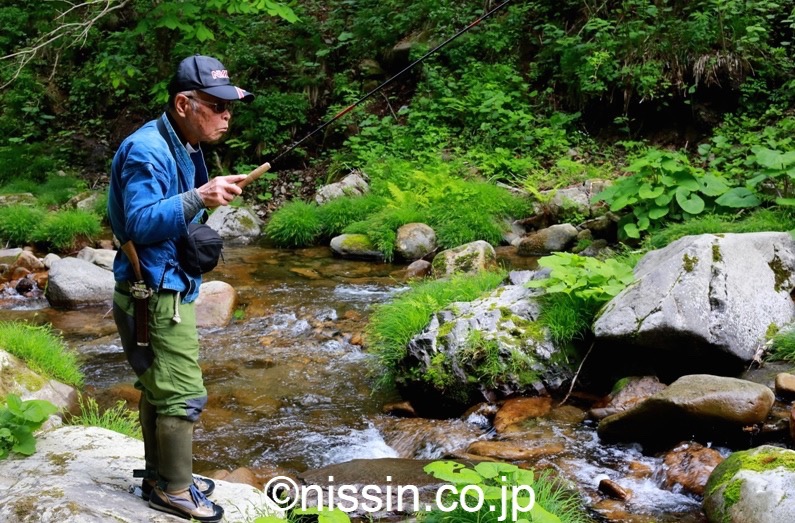
Affichage des articles dont le libellé est Hiromichi Fuji. Afficher tous les articles

dimanche 8 octobre 2017

A tenkara season ends

Since my return from Isère we have entered the summer and it has quickly taken on canicular paces, to the point that given the very rapid rise of the temperature of the water of the rivers (up to 26 ° on some) the fishing authorities have decided to close the trout fishing in all streams whose width is less than two meters.
For myself in the last three months I went fishing only for very short sessions, one hour maximum, and always very early in the morning, the only time of the day when the trout show a little bit of activity.
I left at home the 13 feet rods and more to use only the 360 Nissin Royal Stage offered to me by Fuji sensei during our meeting and also one of his furled fluorocarbon lines.


I have fished the whole summer with a single kebari which is nothing but a "reduced size" version of my Yamato Kebari. The grizzly cock feather has been replaced by hen pheasant and the head has changed from rusty brown to fluo orange.


The month of July was excellent, the temperatures were high but the stable weather allowed me to go fishing every morning knowing beforehand the state of the river; it was very different in August during which the storms were numerous. The month of September began in the rain and storms and fortunately for the trout the level of the rivers began to rise. 
Because of these heavy rains the end of the trout season for me was about two weeks before the official closure but I had no regrets to have since I had fished a lot during the previous months.


The hot summer and the rainy beginning of autumn  have at least a positive aspect: a very good vintage for mushrooms!


dimanche 13 décembre 2015

Japan Kebari: Hiromichi Fuji

Last July during my stay in Japan I had the opportunity and the privilege of meeting a key figure of the history of modern tenkara: Hiromichi Fuji.
He was one of the first angler to use  tenkara as sport fishing and not a commercial technique and has played a central role in the design of modern tenkara rods and lines. During the afternoon I spent in his workshop we did tie some kebari that we traded before we leave.


Fuji-sensei still ties himself all the kebari sold by the NISSIN firm, his long experience of fly tying is noticeable how fast he ties kebari beautiful, simple and whose effectiveness is famous. His vise in a very low position denotes an economy of gestures and if the table is completely covered by equipment and materials Fuji-sensei knows where each item is at. 


The kebari tied by Fuji-sensei on this afternoon were made on Maruto hooks size 号7 and 号6.


This kebari was inspired by the traditional patterns of commercial fishermen from whom Fuji-sensei made tenkara a sport fishing technique. 


These kebari are neither "dry flies" or  "wet flies" because as Fuji-sensei told himself: "That is the angler who adapts the use of his kebari to the situation."
Hiromichi Fuji technique is based on the legacy of professional fishermen and his observation of fishes. 


Fuji-sensei's kebari are perfectly suitable to his tenkara technique that requires great fly presentation delicacy. The economy of materials in the tying process is not only a matter of aesthetics. 


Today Fuji-sensei is still an active member in the tenkara community in Japan through the Kyoto Kitayama Tenkarakai, participating in numerous events on the theme of tenkara and collaborating in the design of rods and lines for Nissin.

lundi 10 août 2015

Encountering the father of modern tenkara

After leaving Yamano-san I went to Kyoto that I visited under thunderstorms and rain which did not make the former capital of Japan less interesting. I visited the sites that interested me early in the morning and late in the evening after the rain stopped. The rainy season has been longer than usual this year and I had to deal with the vagaries of weather during my stay in Japan. I had the chance to stay very close to the most interesting sights of the town so I was not going to let the rain stop me.


After two spent visiting the town and getting to know some of its inhabitants I did meet Yoshiaki Hashimoto, a member of the Harima tenkara club, on the tiny Toji-in station platform.


After a short drive we arrived in residential area where we were awaited by someone whom I would not have not met without the help of Eiji Yamakawa who have known him for many years: Hiromichi Fuji. After introducing ourselves to each other Fuji-sensei invited the both of us to follow him in his workshop. We started talking about tenkara of course while drinking a delicious cup of black coffee. The conversation was warm, relaxed and very natural because Fuji-sensei is kindness made man. 


As we discussed the lines that Fuji-sensei still manufactures today for Nissin I pointed out that these lines, compared to any I have tried so far, are the only ones that really differentiate from one another. Fuji-sensei asked me if I would be interested to see him making some lines and have his explanations at each step of the process, it would be more interesting than a long and boring theoretical speech he said. I obviously  accepted!


First the machine used by Fuji-sensei is unique, it is unlikely any tenkara lines furling machine existing elsewhere, and this for one simple reason: he designed it by himself.


With the explanations and the demo of the master I learned the way he makes furled tenkara lines which can have different actions. I will not describe here the process in detail because it is not to me to do it but to Fuji-sensei who, when the time will have come, will do what it takes to transmit his knowledge of tenkara lines furling. From what I have seen him do I was able to understand what makes his tenkara lines so different than any other furled on the market today and so well adapted to his sutebari.  
After making a couple of lines Fuji-sensei suggested that we try them, proposal that Hashimoto-san and I accepted with enthusiasm. We had planned to go fishing together the day of our meeting but unfortunately Fuji-sensei broke his wrist during a fishing outing a few days before my arrival in Japan. Fuji-sensei is not only a great angler with a great experience in line furling, rod designing and fly-tying he is also a very good teacher who knows how to be understood despite the language barrier. The picture below is the perfect example of a missed cast with projected forearm that inevitable results in your line hitting the water.


Fuji-sensei first asked to reproduce this bad cast which I did and then he demonstrated us the good cast to obtain the best possible result with his lines and then we did see perfectly deploying line with perfect loops. One can obtain very delicate and accurate casts with any of these lines, whatever it is 12 or 20 feet long, if he strokes the rod the good way. These lines and this casting style have been refined for several decades so there is no wonder why they are the best one can use for a delicate fly presentation. It was a memorable moment to watch Fuji-sensei cast in his personal style which perfectly matches his tenkara technique. Hashimoto-san and I took over under the watchful eyes of the master. The rain became harder and we decided to go back to the workshop. 


Back in the workshop the conversation slipped from tenkara casting to kebari tying, a domain in which Fuji-sensei excels. He is not only a rod designer, a tenkara line manufacturer but also a very talented and productive fly tier as he still ties ALL the kebari sold by Nissin today. 


Fuji-sensei was the first to sit behind the vise, needless to say that I instantly knew that I waas dealing with a very experienced fly tier. His tying is very fast because the gestures economy is at a very high level. Hashimoto-san and I will then take place behind the vise of the master and after each of us had tied a kebari we discussed the possible use of this pattern. 


The first time I did sit behind Fuji-sensei's vise I noticed that it was fixed to the table in a very low position which could be be a disadvantage because I am tall but when I started tying the first kebari I understood that this position which leaves very few space under the vise is a good way to avoid unnecessary ample gestures. Once again something refined by a long experience.


We did spend a part of the afternoon tying kebari and sharing our viewpoints about the evolution of kebari through out time, sasoi techniques and many other topics encompassing our passion. It is always rewarding to meet very experienced anglers who have remained simple and true to themselves, this is really what tears apart the common "experts" and the truly great fishermen. 
At about seven o'clock we left Fuji sensei's workshop to have a dinner of soba noodles in a local restaurant and go on talking about tenkara. 
I can not thank enough Fuji sensei for welcoming me in his workshop and being kind to share a little bit of his knowledge with me. 


mercredi 7 janvier 2015

MODERN TENKARA, BOOK BY HIROMICHI FUJI

For a few months now some readers have asked me if I could post some articles about tenkara books and I think that this can be interesting so I have decided to do some.
This first post about tenkara books is about one that I think is very interesting as the author is a very important character in the history of contemporary tenkara: Hiromichi Fuji.


He has been of the first to use this fishing technique in a sports perspective after the disappearance of commercial tenkara anglers in Japan who had never worried about transmitting their knowledge.
In that time very few people were interested by tenkara besides a handful of passionates such as Yuzo Sebata and the journalist Soseki Yamamoto. The "Modern tenkara" book was published in 1990 and is the fruit of a long tenkara experience. 
This books consists in five parts and begins by a generous chapter about tenkara gear and the least I can state is that this chapter has been written by a man who has played a key role in the design and development of contemporary tenkara rods for the Nissin company. Fuji Sensei is also a famous furled taper lines maker. These lines were designed by Fuji Sensei to perfectly fit his own tenkara technique named "sutebari".


The goal is clear: enticing the fish by suggesting a starting hatch. This technique is effective and I often use it when I go fishing in the less productive hours. I have really better results while following the techniques of the tenkara masters than with the easy resort of weighted nymphs. 
Like any good about tenkara there is a chapter about fly tying and in this book it is generously illustrated with very explicit drawings that can be understood even by someone who has never tied any kebari before. I note that at the time when the book was published Fuji Sensei seemed to have a preference for classic tenkara patterns such as the Asahi kebari, the Takayama sakasa kebari and the Gujo kebari. 
The fundamental difference,  in my opinon, between Japanese and French books about fishing is that Japanese authors have heart to share their experience and knowledge while the French ones are more interested by flattering their ego. 


The third part deals with casting and the analysis of streams. This chapter is very well done and its content can be very useful to people who are new to fishing because Fuji Sensei had the great idea to make very clear illustrations. 


This chapter also contains illustrated explanations about the kebari presentation techniques called "sasoi" and I highly recommend tenkara newbies to seriously study these techniques because they can help one to seriously improve his technique and make one realize that in the tenkara world technique is more important than gear. 


The fourth part of the book deals with several topics but one of them especially caught my attention: the vision of salmonids. One can easily find in books, the internet and fishing magazines a huge number of theories about the salmonids vision but I personally never saw anything I could consider as relevant because I have always seen or read about the salmonids field of vision as a perfectly smooth cone. As far as I know a stream is not a perfectly ordered laboratory, trouts prefer living in places nearby an easy access shelter. This sole example, to me, shows that Fuji Sensei wrote his book basing its content on his personal experience and observations with the goal of sharing his ideas, concepts and discoveries.


John Vetterli  of Tenkara Guides LLC was kind enough to write the final part of this post and share his experience with Fuji Sensei with us and I am grateful to him for having accepted my request. 

In June 2014, my business and fishing partner Erik Ostrander and myself had just finished several days of fishing in Itoshiro village with Dr. Ishigaki when our good friend Eiji Yamakawa's van pulled up early in the morning to start a 4 hour road trip to a remote mountain fishing hut outside of Kiyoto that belongs to Horimichi Fuji. Author of several books on tenkara, innovator if NISSIN PALS fluorocarbon furled taper lines, commercial fly tier for Nissin, and designer of the Nissin Airstage Fujiryu line of tenkara rods. 

All the gang. We all slept in two tiny rooms in the hut together. 

When we finally arrived at Fuji Sensei's hut, we were greeted by several members his fishing club and after brief introductions, we were in the river fishing under the watchful eyes of one of the living tenkara masters of Japan.

Fuji Sensei, Eiji Yamakawa, John Vetterli

Fuji Sensei's style or Ryu of tenkara is unique. He likes softer full flex rods and uses his Nissin Pals furled lines. His casting stroke is slower in tempo than most tenkara anglers. He lets the rod completely load on the backstroke before he launches the line forward. He likes the kebari to land very soft, controlled, and fly only on the water. 

Fuji Sensei teaching John the finer points of Fujiryu Tenkara

His teaching is a mix of sternness and easy going fun. He is quick to spot glitches in your cast or presentation and approachable to discussion about how to fix things. 
He is a very warm, generous, good humored man with deep and sincere love of his streams, mountains, fishing culture, and teaching. He is a perfectionist when it comes to casting and presentation. He will push you to achieve and reach your potential. 

Iwana

Fuji Sensei after a long day of fishing

We spent 3 days days living together in his tiny hut. Eating traditional Japanese food, sitting around the charcoal fire every night tying kebari, sharing stories, laughing a lot, and having a hell of a lot of fun. 

Kebari tying and joke telling night

After our last day of fishing we traveled to Fuji Sensei's home in Kiyoto to tour his workshop where he hand ties all the kebari that Nissin sells and the giant machine he designed to build the Nissin Pals furled lines. His workshop is an inspiring place to visit and learn about his line making process and learn about his methods for tying kebari patterns. 

Learning about line making in Fuji Sensei's workshop

Hiromichi Fuji is a living treasure for tenkara anglers all over the world. I am truly humbled and honored to have spent a few days living, fishing, and learning from him. I will always cherish my memories of hanging out with Fuji Sensei.

John Vetterli