Affichage des articles dont le libellé est zenmai-dou. Afficher tous les articles

mardi 20 juin 2017

Tenkara Fest 2017

This year it was in Isère, more precisely in Pont-en-Royans, that we had rendez vous for the third edition of the Tenkara Fest which was going to take place in the Vercors massif.


As every year I arrived first and took rather quickly the direction of a stream that we had planned to fish during these three days ie the Bourne.
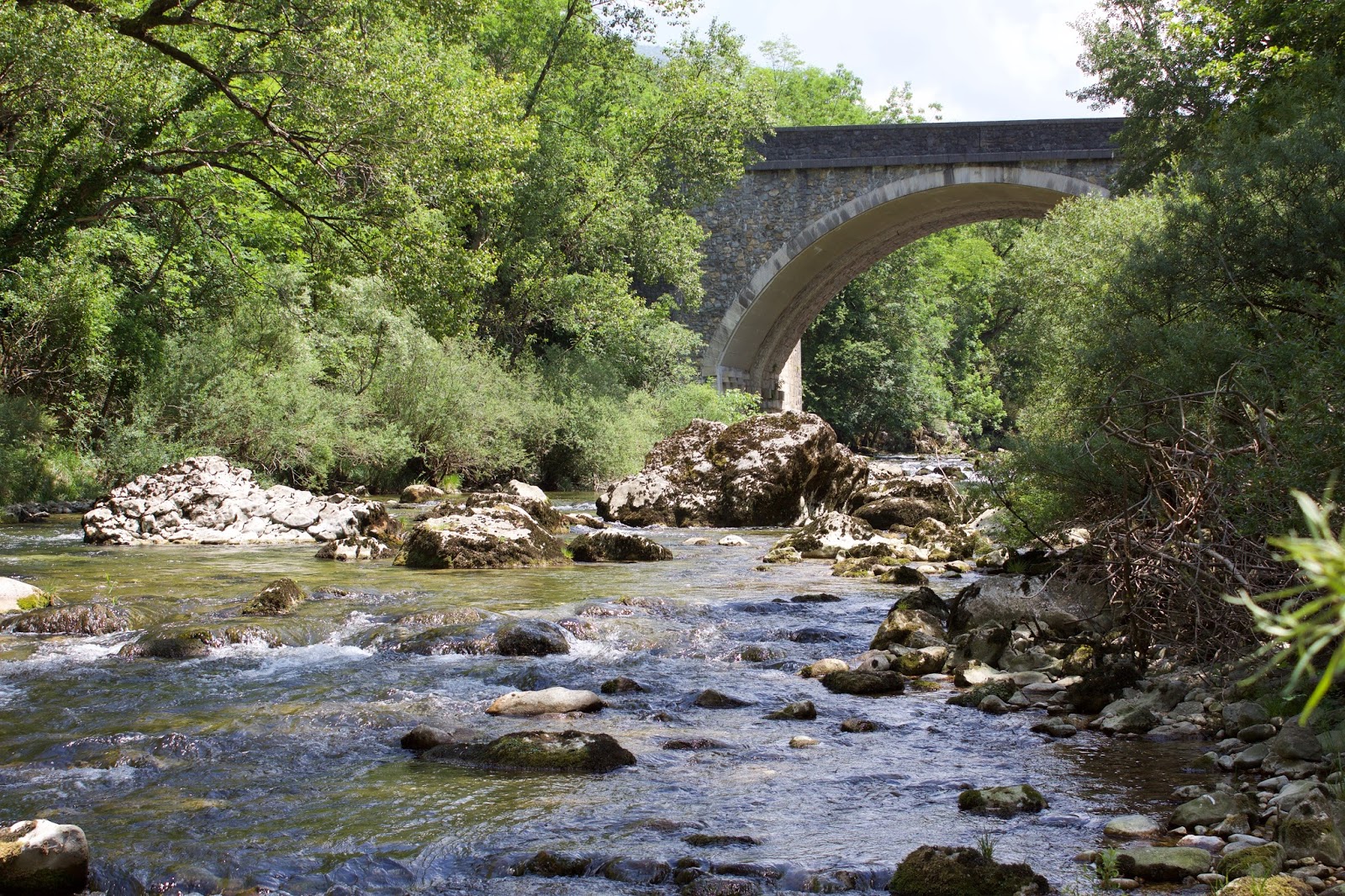


But before fishing I took the time to prepare an excellent lunch on the bank of this beautiful stream bathed in sunshine and took advantage of it to relax after the almost ten hours of my night time drive. It was very hot this friday afternoon, 82 F  in the shade to be exact, and so I did not expect trout to be particularly active. The Bourne is a beautiful stream where you feel incredibly good to look for trout even if this afternoon the conditions were hardly favorable to trout fishing. So I spent a good time observing another tenant on the premises.


Joined by Guilhem we decided to climb further up the river. The atmosphere began to feel strongly stormy but we were confident and wanted to start this weekend devoted to fishing by simply tenkara fishing. In spite of the stormy atmosphere then the wind started blowing but our fishing met the success. Our simple approach to tenkara, faithful to the basic principle of this sport fishing: a rod, a line, a fly, once again demonstrated its effectiveness even in difficult conditions and in my case on streams of which I knew only the name a few hours ago. 


This first fishing session completed, we did hit the road in the opposite direction to join our friend Edouard, who had just arrived at the guest house. We did spend an excellent evening which was followed by a good night of sleep for the day that was awaiting for us the next day. This second day began with our first encounter with a tenkara angler whom we knew only through social networks and I must say that as we had expected, we had the pleasure of meeting a very nice fisherman and really passionate about tenkara. 


After we met, we observed the river where some trout had been stocked for the "fishing festival" and decided to go fishing on the Vercors plateau. As we were driving to the plateau the sky darkened very quickly, and once we reached our destination, we could only see that a storm had swollen the surrounding streams, and we decided to drive back to the gorges of the Bourne where we hopefully found clean and clear waters.


We arrived in the middle of the morning and even at the bottom of these deep gorges the temperature was already very high. Despite the warm weather our morning of tenkara fishing in this magnificent place was crowned with success. We will observe many mayflies but it must be said that during this day they did not seem to interest any fish because only small black kebari were taken by trout. 


The weather forecast was correct and the afternoon ended in a violent storm, it was almost 7 pm when we stopped fishing.


The next day the temperature had dropped sharply and as we found when we arrived on the banks of the Vernaison the water was slightly stained because of the night rain. If the beginning of the morning was rather difficult the fishing became good around noon as the sky uncovered and the temperature rose.


Once again simplicity was rewarded and all trout were taken with zenmai-dou pattern.


In the afternoon I resumed the north road where dantesque storms awaited me and compelled me to cancel the visits and tenkara fishing that I had planned to make in Savoie but I had just spent a weekend with friends passionate of tenkara and that's the main thing.


mercredi 30 mars 2016

ZENMAI-DOU

The last weekend has not been devoted to tenkara fishing because of a violent weather event so I did spend a little bit of time with other activities related to my passion; I started reading an awesome book about which I shall publish something later, and I finally realized a tying video of one of my favorite kebari pattern: the Zenmai-dou.


I posted on this blog in July 2014 a detailed fly-tying sheet and some readers asked me if one day I would make a fly tying video of the zenmai-dou... This is now done!


I hope that you will like this home made video and perhaps will you want to try this kebari as in a tenkara fishing experience it is good, and even advised, to walk off the beaten path.
It is always a pleasure for me to promote these traditional patterns that are the result of a long evolution in the perspective to keep it simple and effective.


dimanche 28 septembre 2014

OWNER HERA PROST HOOKS

About three months ago I did post an article about the dubbing material made from fern fiddlehead fibers known as zenmai with a step by step fly tying sheet of the zenmai dou kebari on an Owner Shinobi hook.

The guenine zenmai dou is tied on golden hooks and I was lucky enough to be offered some by a Japanese friend. A reference I had never heard about: OWNER HERA PROST.


In his letter my friend did write that these were typical shaped for the zenmai dou kebari with wide gap, generously curved bend and barbless point. These hooks have no eye but a small spade so I have no doubt about the strength of ties on these hooks. 
The size I did receive is 8 (号) so I can not really describe these hooks as "heavy wire". I would rather compare them to the Tiemco 100 which can be used for emerges, light nymphs or wet flies not destined to sink like anvils. 


I have been fishing with wet flies long enough to understand that a fly tied with a cock hackle is a wet fly in power. 
Differentiating a wet fly with a wet fly by the use of a cock or of a hen feather is a joke, a hoax in my opinion. If one does not use hydrophobic chemicals any dry fly will dive sooner or later!
Those who know the videos of Dr. Hisao Ishigaki, one of the greatest connoisseur of Tenkara, have certainly understood that the different casting techniques allow to fish subsurface with flies generally considered as dry flies. 

A Tenkara angler understands that he needs to improve his technique instead of switching from one kind of fly to another, that is what teaches us the experience of Tenkara masters such as Dr. Ishigaki or Masami Sakakibara.
At least for me it is clear that it is these veteran practitioners who have something of value to pass on.
It is them who did what it takes for Tenkara not to disappear but instead spread throughout the world.
There is not any master outside of Japan in my opinion, there are sincere apprentices or insincere false experts. 


samedi 5 juillet 2014

ZENMAI WATAGE

There is some time now that I have known that some Japanese anglers were tying kebari with a dubbing whose fibers are from some plants including the Osmunda Japonica fern which is called Zenmai Watage.

Young shoots are harvested in spring to be cooked as these sansai are very popular among the Japanese anglers who roam the mountains in search of yamame, amago or iwana.


I have been really interested by the idea of using vegetable fibers and I find it is logical as in the past anglers certainly had to tie their kebari without buying anything so they were using easy to find materials...what more common than fern in forest covered mountains?!
The spring in my area was literally rotten so I hardly had time to harvest anything to do dubbing from but I am lucky enough to know a shop that is managed by someone who sells some...I did spend a few euros to buy a bag of zenmai watage.

The fibers of this dubbing have a "caramel" color, they are extremely thin and each "strand" is very dense so in my opinion a small quantity of this dubbing is probably enough to tie a huge amount of kebari. After watching carefully these fibers I think they are used as dubbing because of the incredible variations in the color that make these, when tied on hook, look like the skin of an insect  and we all know that bugs are not solid colored. Anyway I am convinced of the merits of these natural materials and they perfectly fit my approach of fly tying which not to use synthetic neither expensive materials.

Kebari tied with this dubbing are called "zenmai-dou". I offer to you a fly tying sheet:

1/ You will need these materials:
    -8/0 black tying thread
    -Zenmai watage fibers
    -Natural peacock herls
    -Cock neck feather (grizzly)
    -Owner shinobi hooks
    -Griffin natural silk (black)


2/ The tools you will need are:
    -A bobin holder
    -A whip finish tool
    -A pair of scissors


3/ Fix the hook in the vice and wrap the tying thread around the hook shank. Trim the excess at the bend of the hook if there is some. 


4/ Cut a strand of silk three times as long as the hook shank.


5/ Bend the strand of silk in half and attach it to the hook shank by tight wraps of tying threads to obtain a strong tapered underbody. Trim the excess of the silk strand. I personally do this to have a 4-5 mm silk loop to make the tying of the tippet easier. 


6/ Dub some zenmai watage fibers on the tying thread. 


7/ Wrap the dubbing around the hook, four turns are enough. Then fix on the hook two natural peacock herls with tight wraps of tying thread. 


8/ Twist the peacock herls together and wrap them two turns around the hook shank. Secure with the tying thread and trim the excess of herls. 


9/ Fix at its foot a cock neck feather on the hook.


10/ Wrap the cock feather around the hook shank. Two turns are enough. I follow the advices of Japanese anglers who do their  hackles sparse; as Rokumi Tsukamoto kindly reminded me not so long ago insects only have six legs! 
Trim the feather excess and wrap your tying thread tight for a few turns to make a strong head to your kebari. Use the whip finish tool to easily make the finishing knot and cut the tying thread. 


Your zenmai-dou is finished! 

In case you don't want to wait for next spring to harvest fern you can purchase this dubbing on the excellent web-shop tenkaraya.com of my friend Keiichi Okushi.
This dubbing is sold in bags that contain 0.12 oz for the price of 6.80 USD, each contains enough dubbing to tie dozens of flies so it is really cheap.