samedi 15 août 2015

Two days with a no-tarin club ambassador

After leaving Kyoto I went to Sannomiya where I was to meet a member of the oldest tenkara club: Kiyoshi Ishihara, a member of , the no-tarin club. 
We did meet at the station as it was planned and after a quick meal at a local restaurant we took the road to go fishing in the Tottori prefecture. We had a three hours drive to go, enough to get to know each other, as until we were only virtual friends on social network, and talk about our common passion for tenkara. It was very hot, the sky was azure blue and we were obviously in a jovial mood. The conversation was very rich and most interesting as Yu Gyojin, Kyoshi's fishing nickname, has been interested in tenkara history, technique and philosophy for a very long time. He first learned by studying everything published dealing with tenkara then joined the famous no-tarin club and through time and experience he has developed his tenkara. 
As we were driving to our destination the sky was darkening but our enthusiasm remained unspoiled, we were not only happy to go fishing together but we also realized that we had a lot of common viewpoints about many topics. 


Before arriving to our destination we did a slight detour to a beautiful ancient temple that was built in a cave, one of the most unusual place. Meanwhile the weather continued to deteriorate and as we were driving the last miles before arriving on the banks of the Hiketa-sawa the first raindrops began to fall. 


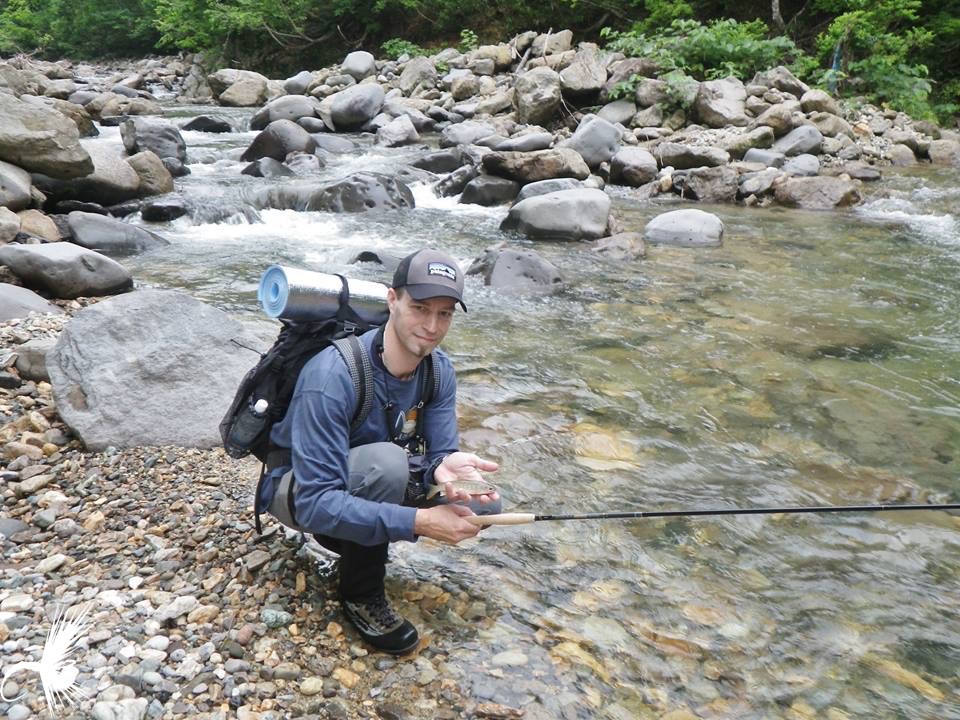
I let Ishihara-san fish first as I think that it is never useless to watch an angler fish especially if he is more experienced than yourself. One can learn a lot if you are willing to. 


It did not take him a lot of time to catch the first fish. We were very happy to see that the capricious weather conditions did not disturb the fishes as much as one could expect. We fished in turn because the stream is pretty narrow and has a lot of overhanging trees thus we were wading upstream slowly to check all the possible spots likely to be inhabited by a yamame. 


We arrived at the point of the stream where with the altitude increasing the current becomes more powerful, the water colder and where yamame give way to iwana. 


Fishing for iwana is different from yamame or amago fishing but it does not require any gear change, one can use the same line, even the same kebari. The angler's technique has to adapt to the fish behavior and what I had learned a few days before in Tadami has been really useful to me. 


Hours passing by we did spend increasingly long minutes under the trees during showers and the catches of iwana became also less regular. The tension in the air was palpable, the grey sky was growing darker and darker so when the first thunderclap rung we decided to collapse down our rods and go back to the car. Once arrived at the car Ishihara-san told: "We played very well!". I agreed with him. It was really worth fishing in the rain. 
After changing our clothes as fast as possible we jumped in the car and took the road to a local ryokan where Ishihara-san is used to go when fishing in the area. We were happy with our fishing day, very stormy but productive. At the ryokan where we were warmly greeted by the hostess we spent a great evening which was devoted to only one topic: tenkara. Ishihara-san has a very rich fishing culture and he is not stingy with it and I really liked talking to him and cohabit with him. 


We both fell in the arms of Morpheus without the slightest resistance...Maybe with the hope to meet the tsuchinoko during our sleep. 
The next morning we got up at dawn but finally took time for a delicious breakfast because it was already raining. We set our plan for the day: fishing two short tributaries of the Hatto-gawa because Ishihara-san was afraid that the heavy rains of the previous and even more those of this morning had made the main streams of the area in a very dirty state. Thanks to his idea we had a plan "A" and a plan "B".
So during this fishing day we caught, without surprise, less fishes than the day before but it is very good for a tenkara angler, if not scared of challenges, to cope with difficult conditions. It is even the best way to improve your technique.


After exploring the Hosomi-sawa and the Kurumino-sawa and watching beautiful iwana we deicided to back to our starting point. In the beginning of the afternoon the rain did become even harder as we were back on the road to Kobe, where we were expected, discussing many topics related to tenkara, music, and many more. I have much sympathy for Ishihara-san who is not only a great tenkara angler but also a very cultured and incredibly kind man. After a little bit more than four hours drive we arrived in Kobe city where I met for the first time Eiji Yamakawa and Nishi-san.


We spent a great evening talking about all things tenkara, the passion that had brought together. 
It is truly a privilege to meet sincere tenkara enthusiasts who have acquired from a long experience a wealth of knowledge about tenkara and who are, even if they do not like this title, masters who have a sincere pleasure to share their tenkara. 

lundi 10 août 2015

Encountering the father of modern tenkara

After leaving Yamano-san I went to Kyoto that I visited under thunderstorms and rain which did not make the former capital of Japan less interesting. I visited the sites that interested me early in the morning and late in the evening after the rain stopped. The rainy season has been longer than usual this year and I had to deal with the vagaries of weather during my stay in Japan. I had the chance to stay very close to the most interesting sights of the town so I was not going to let the rain stop me.


After two spent visiting the town and getting to know some of its inhabitants I did meet Yoshiaki Hashimoto, a member of the Harima tenkara club, on the tiny Toji-in station platform.


After a short drive we arrived in residential area where we were awaited by someone whom I would not have not met without the help of Eiji Yamakawa who have known him for many years: Hiromichi Fuji. After introducing ourselves to each other Fuji-sensei invited the both of us to follow him in his workshop. We started talking about tenkara of course while drinking a delicious cup of black coffee. The conversation was warm, relaxed and very natural because Fuji-sensei is kindness made man. 


As we discussed the lines that Fuji-sensei still manufactures today for Nissin I pointed out that these lines, compared to any I have tried so far, are the only ones that really differentiate from one another. Fuji-sensei asked me if I would be interested to see him making some lines and have his explanations at each step of the process, it would be more interesting than a long and boring theoretical speech he said. I obviously  accepted!


First the machine used by Fuji-sensei is unique, it is unlikely any tenkara lines furling machine existing elsewhere, and this for one simple reason: he designed it by himself.


With the explanations and the demo of the master I learned the way he makes furled tenkara lines which can have different actions. I will not describe here the process in detail because it is not to me to do it but to Fuji-sensei who, when the time will have come, will do what it takes to transmit his knowledge of tenkara lines furling. From what I have seen him do I was able to understand what makes his tenkara lines so different than any other furled on the market today and so well adapted to his sutebari.  
After making a couple of lines Fuji-sensei suggested that we try them, proposal that Hashimoto-san and I accepted with enthusiasm. We had planned to go fishing together the day of our meeting but unfortunately Fuji-sensei broke his wrist during a fishing outing a few days before my arrival in Japan. Fuji-sensei is not only a great angler with a great experience in line furling, rod designing and fly-tying he is also a very good teacher who knows how to be understood despite the language barrier. The picture below is the perfect example of a missed cast with projected forearm that inevitable results in your line hitting the water.


Fuji-sensei first asked to reproduce this bad cast which I did and then he demonstrated us the good cast to obtain the best possible result with his lines and then we did see perfectly deploying line with perfect loops. One can obtain very delicate and accurate casts with any of these lines, whatever it is 12 or 20 feet long, if he strokes the rod the good way. These lines and this casting style have been refined for several decades so there is no wonder why they are the best one can use for a delicate fly presentation. It was a memorable moment to watch Fuji-sensei cast in his personal style which perfectly matches his tenkara technique. Hashimoto-san and I took over under the watchful eyes of the master. The rain became harder and we decided to go back to the workshop. 


Back in the workshop the conversation slipped from tenkara casting to kebari tying, a domain in which Fuji-sensei excels. He is not only a rod designer, a tenkara line manufacturer but also a very talented and productive fly tier as he still ties ALL the kebari sold by Nissin today. 


Fuji-sensei was the first to sit behind the vise, needless to say that I instantly knew that I waas dealing with a very experienced fly tier. His tying is very fast because the gestures economy is at a very high level. Hashimoto-san and I will then take place behind the vise of the master and after each of us had tied a kebari we discussed the possible use of this pattern. 


The first time I did sit behind Fuji-sensei's vise I noticed that it was fixed to the table in a very low position which could be be a disadvantage because I am tall but when I started tying the first kebari I understood that this position which leaves very few space under the vise is a good way to avoid unnecessary ample gestures. Once again something refined by a long experience.


We did spend a part of the afternoon tying kebari and sharing our viewpoints about the evolution of kebari through out time, sasoi techniques and many other topics encompassing our passion. It is always rewarding to meet very experienced anglers who have remained simple and true to themselves, this is really what tears apart the common "experts" and the truly great fishermen. 
At about seven o'clock we left Fuji sensei's workshop to have a dinner of soba noodles in a local restaurant and go on talking about tenkara. 
I can not thank enough Fuji sensei for welcoming me in his workshop and being kind to share a little bit of his knowledge with me. 


vendredi 31 juillet 2015

Encountering a bamboo craft master: Masayuki Yamano

After leaving Sebata-san and my genryu fellows I did go to Kawaguchi where Yamano-san and his wife were waiting for me. We could unfortunately not meet when they did come in France last winter so I wanted to take advantage of my trip to Japan to meet Yamano-san, a very talented craftsman who makes absolutely amazing bamboo rods. I think his creations are truly artworks.


We spent a great evening to get acquainted, talking about tenkara, cuisine, bamboo as well as architecture and wine. Before leaving Yamano-san invited me to visit his shop and workshop the next morning. 


Yamano-san introduced me to the different types of bamboo rods he makes, of course tenkara and keiryu rods but he also makes some for tanago, hera. He does not only makes rods for fixed line fishing but also freshwater and saltwater spinning and casting rods. I have been amazed by the incredible beauty of every rod in the shop.


I did ask a lot of questions to Yamano-san about the process he follows to make his bamboo rods as it was a unique opportunity to learn from someone who really masters this process. Yamano-san was kind enough to answer my many questions and I have learned a lot about the making of bamboo tenkara rods.


Yamano-san thought that nothing is better to learn than seeing a craftsman at work did for me a demo of the main steps of his process to make a bamboo tenkara rod. After choosing a section of bamboo he started straightening it.


I had already seen this operation being performed on several videos but I did not realize the speed with which this operation was performed. Yamano-san handed me the bamboo section and it was perfectly straight. My host invited me to take his place and try to repeat the same operation...


It took me obviously more time to straighten a shorter section of bamboo but with the Yamano-san's advices I finally got a decent result. I am grateful to Yamano-san to give me this opportunity because it made realize how what seems simple on video requires knowledge and experience to be properly performed. It probably takes long years of practice to reach the mastery of Yamano-san. We talked about it and he told that he has done this job his whole life and was taught bamboo craft by his older brother.
Then we went to the workshop which is usually not open to the public.


Seeing several boxes of gimlets opened I asked my host to explain me the use of these tools and rather giving a theoretical answer to me Yamano-san performed this step of the process on a bamboo section. The goal of this step is to remove matter from the inside of the bamboo section to make it light enough to be used as a fishing rod section.


If the principle of this operation is simple, its proper application still requires training as I was realizing. The blade of the gimlet used here is very short and the machine has no guides. I am grateful that Yamano-san made me try because it was a good way to realize the effort it takes to properly work bamboo in rules.


The last step of the processus to make a bamboo rod is to lacquer the sections joints and Yamano-san executes this step in the very traditional way with a small brush made of human hair. This step of the process is, in my opinion, the most delicate of the whole process and I watched admiringly Yamano-san do this. He uses urushi but also may use other traditional techniques and noble materials such as maki-e or raden.


I did not test this step because I did not want to waste a piece of bamboo neither urushi which is a rare and very expensive material. I asked Yamano-san how many years were in his opinion necessary to master the complete process and he answered me that ten years of learning and training were necessary to be able to produce rods that match anglers requests. I am really happy to have had the opportunity to meet a craftsman which such a talent who is willing to make people discover his work and creations.
These beautiful handles, that would perfectly fit on a tenkara rod, are some of the many examples of the magnificent creations of Yamano-san.


I ended my visit by the attic where Yamano-san stocks thirty different kinds of bamboo  that will take five to years to perfectly dry before being usable for fishing rods and other products such as rods handles, rod holders, creels, etc. 
As I suspected when manipulating different keiryu and tenkara rods and feeling their action a craftsman such as Yamano-san combines different kinds of bamboo in the same rod to obtain rods with different actions. 


Thanks to Yamano-san and his wife for welcoming me into their shop and taking a little bit of their precious time to intriduce me to a craftsmanship of exceptional quality.
If any of you is looking for a high quality bamboo tenkara rod made by a talented craftsman who masters the job like very few are able to you can get in touch with Yamano-san via his website saosyosaku.com because this is one of the best addresses to know.


samedi 25 juillet 2015

Genryu tenkara


If I have not posted anything on my blog for a month it is not that I am tired of this blog but I was gone in Japan and instead of blogging during my stay there I decided to live each day to the fullest. Now I am back in my country I have time to post articles about my experience of tenkara in Japan that will undoubtedly have a great influence on my tenkara in the future.

After one day and a half in Tokyo I did meet with Keiichi-san in Mito station from where we had planned to go to Tadami. I have been in touch through Facebook with Keiichi-san for about two years now but I never had the opportunity to meet in real life but I did not have any doubt about the fact that we would get along. When we did meet we instantly talk to each other like old friends! Out of the station we took  Keiichi-san's car to Tadami where the famous Sebata-san was waiting fo us. IThe house where the Tenkara master lives is an old "bansho", a check point between prefectures. 


We did arrive late in the evening but Sebata-san did welcome us warmly. 
While waiting for our friends to arrive we had sansai lunch and drunk beer and sake with Sebata-san. We did talk about genryu fishing, sansai, the history of tenkara, Sebata-san's philosophy and I am really grateful to Sebata-san for sharing his knowledge and opinion with me. 


Our friends did arrive one after one late in  the night, once we were all gathered we went to sleep a little bit. At half past five we did get up and got ready to go fishing. It is rain season in Japan, my previous day in Tokyo was very wet and humid, but this morning the temperature was not so high and cloud custers clung to the sides of the surrounding mountains. The weather forecast was good so one could hope that we were going to have a very good genryu fishing trip. We did leave the village aboard a small van that dropped us after a thirty minutes drives on a parking lot along a small mountain road from which we will walk to the Kanuzogawa. Arrived on the banks of this beautiful stream we had breakfast. Tsurumi-san, Takano-san and I got our rods ready but we did not catch any fish on the last mile before the confluence of Kanuzogawa with the tributary that we had planned to fish during this genryu fishing trip.
Before we left his home Sebata-san told us that this part of the stream was dramatically damaged three years ago by floods and that the iwana population was slowly recovering. I did catch my first fish in Japan a few meters downstream to the confluence of Kanuzogawa with Akakuzure-sawa: a small iwana. 


It was bout 10 a.m when we arrived at the place of the "temba", our base camp. We got everything ready and had breakfast. Onigiri and spaghetti were delicious!


Then we started fishing and wading upstream from the base camp. The average size of the iwana was bigger as we were going more upstream. Iwana are not trouts but chars. As I am not used to fish this kind of fishes I did ask my fellow anglers their technique and they were good advisors because I only had to do what they told me to catch a lot of iwana. But to me the best aspect of this genryu fishing trip was to meet them. Catching even more iwana in bad company would have brought me less pleasure than fishing with my friends. 


I did fish during this genryu trip with only one kebari: the zenmai-dou.


We were fishing one after one, without any hint of competition. We were all happy to see each of us catching fish. 


We had great times fishing together and the stream was very generous with us. The conditions were very good for successful fishing.


In the narrower parts of the stream there were still a lot of snow bridges and it is a few meters upstream one of them that I did catch a beautiful "shaku-gami" iwana. One "shaku" is a length of about 31 centimeters which is considered as big fish in this kind of mountain stream. This fish escape from my net just at the moment when Takano-san was about to take a picture! We were very surprised by the liveliness of this iwana. My friends congratulated me warmly for catching this very nice sized iwana. 


As we were going further upstream the snow bridges were more numerous and higher. As iwana need cold water we were enthusiasts when climbing these snow bridges but had to be very careful. 


By the end of the afternoon we did arrive at a very narrow spot with a very thick snow bridge and as we did not have any climbing gear Keiichi-san and Ito-san decided that it was time to go back to the temba. Japan is the sunrise country but also the "early night" country. I was filled by this first day of genryu tenkara fishing. 
Back at the temba we picked up firewood and I also picked up zenmai along the stream. Once the fire burning we all relaxed drinking an ice cold Asahi. 


Tsurumi-san cooked yakitori, chanko-nabe and ramen. We did take our time and did eat while discussing about genryu fishing, tenkara, fishing in France and many other topics related. We had a lot of fun during this evening in the mountains. 


I will keep a very good memory of this genryu fishing trip. 
After a few hours of sleep we were awaken by the unpleasant sound of rain slapping on the tarp under which we were sleeping. As none of us was motivated to go fishing under the rain we did take the time for a breakfast of steamed rice. Then we dismantled our base camp before heading the confluence of Kanozugawa and Akakuzure-sawa from which we were going to fish the upper part of Kanozugawa. 


The fishing was not as good as it was the day before, perhaps because of the rain. We did catch only a few iwana during the morning. They were beautiful but it was really hard to meet success.


During this two days genryu fishing trip I think that we really had great times, has lot of fun, caught beautiful fishes in very nice places and all that in a very good atmosphere. Around noon the last iwana caught and released we did collapse our rods and begin walking downstream. 
Back at the confluence of both streams we had explored we stopped along the stream to take our lunch. 


This lunch made us he greatest good and gave us energy for the last miles we had to walk to Tadami. We will make a detour to a village nearby to go to the onsen because we needed to wash ourselves and also to relax after these couple of days with very few sleep. 


Back in Tadami we had a memorable party with Sebata-san and other friends of his who share our passion for tenkara. Sebata-san is a great chef and he had prepared an excellent menu.


The evening was rich of discussions about all things tenkara and genryu but also was a great moment of fun as Sebata-san has a great sense of humor. He does not take himself seriously. We had not slept a lot the last couple of days but we wanted to enjoy this moment to the fullest and kept awake late in the night. 
The morning we did wake up early to go fishing yamame in the valley and despite his back aches Sebata-san came with us. We watched him fish the first pool of the stream and I think that we all admired his wasting which is very delicate and accurate. 
The fishing was very though the whole morning and I caught three small yamame, Takano-san hooked a big one but it managed to go away before being landed. 


It was about noon when Sebata-san invited us to stop fishing and go eating soba noodles. After almost three days spent together it was time to part. Three days I will never forget.