Affichage des articles dont le libellé est Masami Sakakibara. Afficher tous les articles

mardi 23 février 2016

Japan Kebari: Masami "Tenkara-no Oni" Sakakibara

It is rare to have the opportunity to meet the people who inspire us and thanks to whom we have developed a passion for something but I am gifted to have the pleasure to go fishing with the man who made me discover tenkara: Masami Sakakibara


With his thirty five years experience in the field of tenkara Masami Sakakibara's style is the perfect illustration of the highest skilled master. Faithful to the basic principle of tenkara "A rod, a line, a fly"
he has developed his technique instead of carrying a lot of tackle. Oni tenkara is not only simple but also very efficient and it is explicit when one sees his kebari and thinks a little about it. I think that the Tenkara-no Oni style of fly tying can be resumed by a simple motto: "design matches function".


This kebari tied by Masami-san is probably his most famous pattern. He is used to name his patterns from the materials used, in this case "Oni black pheasant kebari". What has in first place made this kebari famous among western tenkara anglers is its size as Masami-san ties it on hooks up to size 2. But function dictates design and size and this kebari is designed to be used in the sasoi technique.


Masami-san uses Tiemco "pellet dubbing", which is a natural substitute for seal fur, for the body of this kebari; a hen pheasant feather on a Gamakatsu S10 hook.
The next kebari is Masami-san's interpretation of a Mayfly, a huge ephemera, it is realistic by its size but impressionistic by its design.  I think that this describes very well Tenkara-no Oni style of fly-tying.


The body is made of polypropylene yarn and that is a good product if one wants low floatation kebari. The hackle will give the illusion of life to this kebari when on the water surface. 


If fishing big streams with long level lines has become a kind of hallmark of Tenkara-no Oni style he is also a very experienced and skilled small streams tenkara angler as I got to realize during my stay with the Team Oni in the mountains. 


To fish in shallow mountain streams small sized , in relation with the observable small insects, and light kebari are needed to obtain natural drifts. Masami-san is accosumated to tie his small sized kebari on Tiemco 2499-SP BL hooks that as he says have great features for small streams tenkara fishing: short shank, wide gap and laser sharp point. 


Masami Sakakibara's experience shows that it is possible to practice successful tenkara fishing on any water with his "simple" kebari because he has developed his technique on rational analysis of his fishing and fish behavior. 


Masami-san has developed over the years a tenkara fishing system that is not only simple but also very effective. I would even personally say that the Oni tenkara style has become so effective because it has been kept simple throughout the years. While fishing with him in the mountains I understood why his nickname is "Tenkara-no Oni", the Tenkara demon. As he says himself: "A tenkara angler must be one with the stream". 


If you want to learn more about Masami Sakakibara and the Oni tenkara style I invite you to check his awesome blog


lundi 1 juin 2015

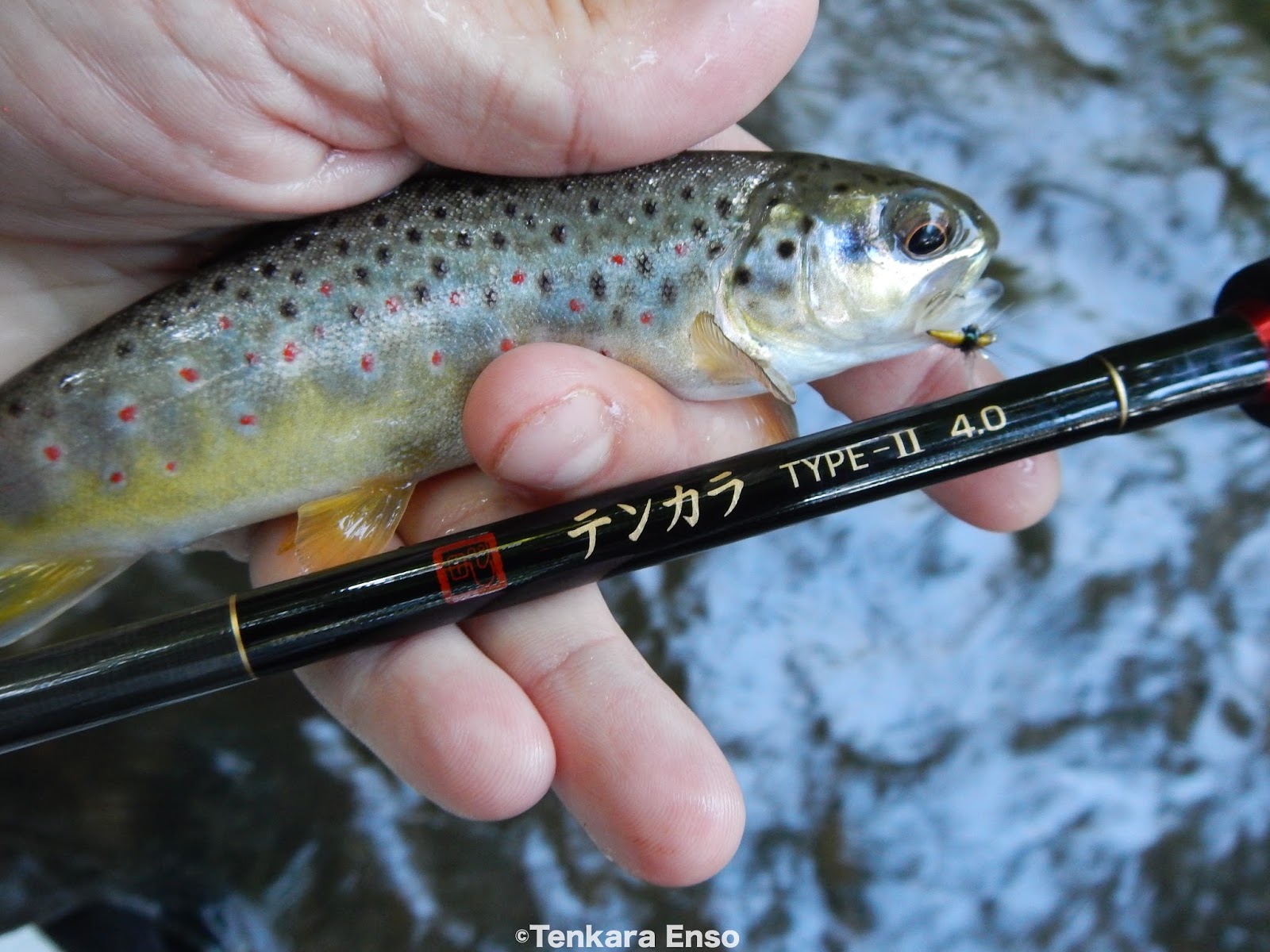
Oni type 2 rod

As I did write a few days ago I am back today to post a initial review of a great rod I have been fishing with a lot lately: the Oni type 2 rod.

Let's start with its characteristics. 
This rod is 4 meters longs, in 8 sections, and weighs 90 grams. Just like the Oni type 1 its weight is a little higher than its competitors of same length but the balance of Oni rods is so perfect that they literally feel weightless when casting. Oni rods are very surprising on this aspect and every time I have made someone test one of these rods they just did not understand how a 4 meters long rod can feel so light. 


The black foam handle is one foot long and its shape allows several ways to hold it. Something I have discovered about foam handle is that I really like because it is very comfortable and has a big advantage if like me you are very meticulous with your tenkara gear: the only thing needed to give the handle its brand new appearance is a little bit of clear water. That is not the same thing with cork handle once they have started blackening. 


The tip cap which is made of hard plastic is perfectly adjusted to the diameter of bottom section, the bottom cap is pretty small and features a slot coin and a drain hole. It is knurled as well to make it removable without tool. This small sized and rounded cap is really appreciable if you like to handle your rod by the bottom with the cap in the palm of the hand. A rounded cap is definitely a plus compared to flat caps of bigger diameter.


Aesthetics is sober and finishes are very high quality. One can check the slightest details of this beautiful rod  and be assured he would not find any flaw. This rod is not only beautiful it is also a high performance fishing tool.


This rod has very high quality in its design, its aesthetics and its production but all these qualities would be nothing if the Oni type 2 rod was not a high performance fishing tool. This is to me the most versatile 4 meters long rod I have tried to date and this is very important because I think that versatility is one of the criterion that distinguishes exceptional rods from the mass. 
I really want a tenkara rod that can be performant with any kind of line I might use and the Oni type 2 rod is that kind of rod. 
My go to line is fluorocarbon level line, especially the Nissin Pals size 3 but I am also a fan of Okaniwa-san titanium lines  . Nylon tapered lines are also very good on the Oni rods.
Like the other Oni rods there is no mention of the action on the rod but the Oni type 2 is a 5:5 which is very good for the angler who is looking for clean presentation of their kebari. This rod has a really smooth casting stroke and I really like it, it is really not tiring on long fishing outings compared to stiffer rods.
As I did write in a prior article this rod was designed by Masami Sakakibara to perfectly match his long light line style and if you respect the natural casting stroke of the Oni type 2 you will effortlessly cast long lines. I have been surprised how easy it was to obtain very accurate casts with the "Long Type" tapered lines that have designed by Masami-sensei. 
You will see a lot of pictures, and probably videos, of this amazing rod on this blog in the forthcoming weeks and months because I have a lot of pleasure to fish with it and this great tool will help me improve my technique.

Like the couple of other rods designed by Masami-sensei the Oni type 2 has become for me the master standard to which I compare the other rods I might try. European anglers can purchase the Oni type 2 rod from Tenkarastyle.com, American anglers can get it from Three Rivers Tenkara.

jeudi 28 mai 2015

First evening rise of the season

May has not been a very productive month for me as a tenkara angler, I have not gone fishing a lot because the weather can be summarized by two words: rain and wind. 
The level of water in the main streams of the area have not been so high for long and their waters are strongly stained. During the last days the weather has been a little better than the average so I did my very first evening rise fishing yesterday. This outing was short. We are very close to June which is supposed to be the door to summer but the weather is not sunny as it is supposed to be. 


This outing was only one hour and I did fish several spots that I know very well to be inhabited by a good density of only wild brown trouts but my approach was realistic about fish activity: they are not hungry at all! But I still better results than the duet of dry fly fishermen I talked to after fishing who were leaving the stream skunked because they had been waiting for trouts to rise on hatching mayflies. Perhaps will I practice dry fly tenkara if I were in an area where the stream conditions are favorable to this technique but for now when I am fishing at my local streams nothing can beat the yellow Takayama sakasa kebari I have had tied to my tippet  for three seasons now. 


I was fishing with the Oni Type II rod, a real one of a kind rod about which I will post a complete review later on this blog, whose soft action is really great for the angler who wants accurate casts and a slower casting stroke that allows the use of long light level lines. I was using it with the minimum length, in my opinion, that Masami Sakakibara had in mind when designing his rod: 5 meters. 


On the trail back to home I was smiling thanks to this short hour of tenkara. I had to adapt to the stream and weather conditions but I was rewarded by a little bit of success. When the water level will be lower I will do longer sessions and bigger trouts will be active on food.
Being on the right spot at the right time will be my only matter!


samedi 4 octobre 2014

TENKARA KNOTS

As soon as a trout season is finished some people start thinking about the next one and I must say my pleasant surprise to see people getting in touch with me to get the basic infos about tenkara with the plan to fish with this technique next season.
Obviously it makes me happy to see new Tenkara practitioners coming and it is always a pleasure to answer their questions. Their basic questions are almost always the same even though I have noticed that people with no experience in fishing often have the most useful questions.
Today, in order to answer the #1 question I have been asked lately, I post a video by Masami Sakakibara showing the knots he uses and that I use myself. As you will see these knots are simple.


samedi 19 juillet 2014

TRUE CASTING

I share today two very good videos posted on Youtube and I think they are worth being shared because they demonstrate the uselessness of false casts.


Since I fish Tenkara I managed to completely eliminate false casts and replace them with "true casts", those who put my kebari in the field of vision of the trouts. As everyone knows salmonids feed mostly underwater and little on the surface. And never ten feet above the stream!

Some argue that false casts are used to cast a bit further but this argument which may be valid for fly fishing does not stand regarding a tenkara rod on which the line is fixed. 

If I fish only with unweighted wet flies it is because I am convinced that if some experienced Japanese anglers use this kind of pattern for decades they certainly have a good reason to do.

As said Masami Sakakibara in the interview I did with him in May: " Tenkara was done with a line and a fly and making the kebari sink was only done by using the streamflow."
These words are also included in many of the books published by Japanese Tenkara masters such as Dr. Hisao Ishigaki in his book "Very clear level line Tenkara":


I do not want you to fish tenkara like this or like that but it is inconceivable to me not to consider the experience transmitted by those who know the most about this technique. 

Give true light wet flies a try and you will quickly understand the advantages over weighted patterns and false casts. 


samedi 14 juin 2014

TENKARA-NO-ONI KNOTS

I often receive mails from tenkara starters about the knots to be used to link the line to the rod, the tippet to the line and the fly to the tippet. This question often comes with lo-fi pictures or incomprehensible diagrams and I thought it was time for an adequate response.
This adequate, clear and definitive response was given by Masami Sakakibara aka Tenkara-no-Oni...


mardi 25 mars 2014

ONI "TYPE III" TENKARA ROD

A few weeks ago Masami Sakakibara-san, aka Tenkara-no-Oni, announced the release of a new range of tenkara rods and after several visits on his blog in a few days I did decide to purchase a "Type III" model.

After a few em-mails my order was recorded and the only thing I had left to do was wait for the parcel to be delivered. I do not know how it is for you, my fellow readers, but when I wait for a parcel the wait always seems endless...Finally the receipt is signed and the rod in my hand!

Theoretical characteristics are:

Length: 11.15 ft
Closed Length: 23.6 in
Weight: 60 gr
Segments: 7
Handle Length: 11.8 in
Handle: camouflage foam
Action: 5:5
Made in Japan


Like most Japanese rods the Oni rod is sold without a tube, you can chose between two different patterns for the sock. The one I have chosen is simple and beautiful. Exactly what I like.
The rod is sent in a PVC tube that allows it to travel safely, the tube is so well closed you will need a sharp boxcutter to open it.


The rod I did receive perfectly matches the theoretical characteristics except for the weight of my rod that is 61,5 grams.
The butt cap is golden. It is knurled and has a coin slot, that is the first time I see the both features on the same cap. The foam handle has a camouflage pattern, that is also a one of a kind feature of this rod.
I really like this uncommon appearance which is enhanced by the metallic purple winding check.


The blank inscriptions are clear and simple; Tenkara-no-Oni's hanko, Tenkara written in katakana followed by the model's name "Type III 3.4". These inscriptions are simple, clear and discrete.


The lilian is short (1.57 inches) and its ligature on the blank is impeccably done. Each of the seven segments is finished by a thin golden border. As I expected the achievement of these small details is impeccable. 
The taste of well done work is really palpable.

The parcel I did receive also contained a letter, a small box with three of the flies used by Masami-san and a fabric pouch with a level line; once you have opened the package you are ready to go fishing. I have to say that it is extremely rare in Europe to receive a tackle order that contains anything more than the invoice. 
This is a good point for the Oni Shop to add a bit of relationship in a business transaction. 
After the unpacking euphoria I decided to take advantage of a sunny moment to go testing the casting ability of this superb rod. I could not expect catching anything because of the chocolate milk color of the stream but I could not bring myself to put the rod back in its sock before I had tried it.

As soon as I had the rod ready to cast I realized that this rod had one more thing I like about her; the handle has not only an uncommon look but is also incredibly comfortable and offers three different grip options. This detail is very important for me.
The sensations provided by this rod are incredible! Imagine your fly is remote and you can cast it wherever you want...This 5:5 action rod is quite powerful and does not need any false casting if it is used with a well balanced line and fly ensemble. 
I tested it with the 4 号 line I did receive with the rod and a size 10 Takayama kebari, the balance was perfect and the light breeze did not necessitate any false casting. As soon as the weather and water level conditions get better I will do a complete field test of this great rod.
Stay tuned...