Affichage des articles dont le libellé est 毛鉤. Afficher tous les articles

vendredi 3 janvier 2020

A very difficult 2019 tenkara season

As I had planned a few days before this opening of trout fishing all the bad conditions had been met to make fishing as difficult as possible. On the opening saturday I arrived as usual at 7:30 am near the stream where I planned to fish but this year despite the distance which separated me from it I already heard it which is rather bad sign because when it happens it is that it is flooding.
Given the heavy rains that preceded this long-awaited day I was not surprised, I can even say that I expected it.


To access the stream I cross a wild meadow, always passing in the same place, and at each step I plunged up to my ankle in the ground so much it was soaked and once the stream in front of me I could only to notice its brownish hue which did not bode well. Usually this is where I prepare my rod and start fishing, but this time I didn't do it. I did not prepare my cane since the stream was impenetrable. So I went up the stream hoping that when approaching its source the water would be clearer but it was hardly lost; the eleven kilometers were uniformly stained by the silts displaced by the current.


This opening of the trout fishing season started very badly. March and April passed without any fishing opportunity because the weather was so bad. Finally at the beginning of May, spring began to settle in the area and I took the opportunity to devote a little time to fishing the local streams. The fishermen must have been really discouraged from the start because I did not meet anyone on any river which is rather rare because these small streams are usually well frequented by natural baits anglers.


I had to wait until the beginning of May to finally benefit from favorable conditions for trout fishing. From mid-June the drought and the heatwave did begin and I decided to stop fishing for this season with the hope that by the end of the season the weather would be seasonal and that the conditions would be good to at least enjoy September weekends to enjoy the streams. This was not the case since from the beginning of September the rain and thunderstorms were almost daily reducing to nothing any hope of ending this very brief fishing season by fishing.


mardi 20 juin 2017

Tenkara Fest 2017

This year it was in Isère, more precisely in Pont-en-Royans, that we had rendez vous for the third edition of the Tenkara Fest which was going to take place in the Vercors massif.


As every year I arrived first and took rather quickly the direction of a stream that we had planned to fish during these three days ie the Bourne.


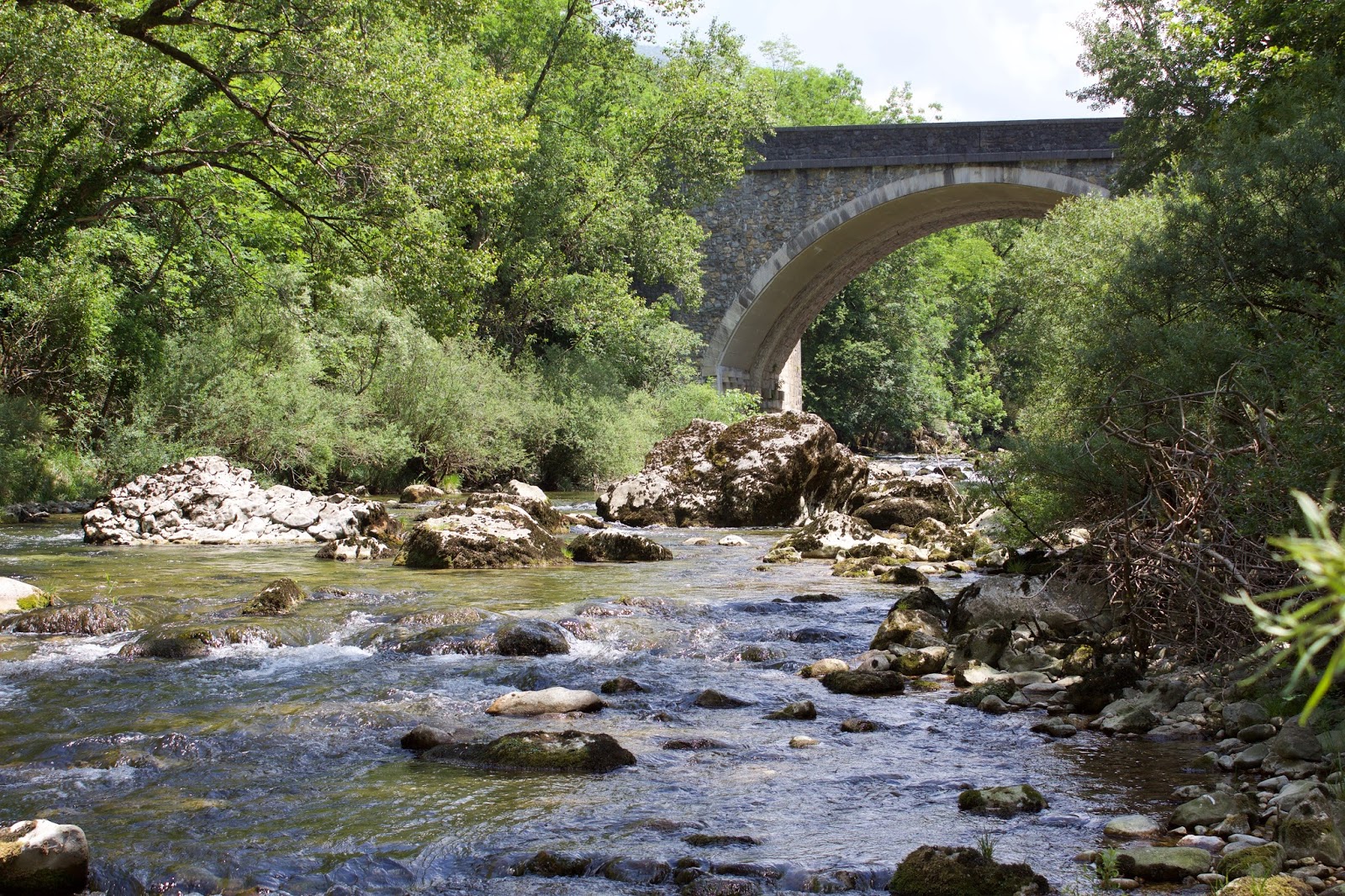
But before fishing I took the time to prepare an excellent lunch on the bank of this beautiful stream bathed in sunshine and took advantage of it to relax after the almost ten hours of my night time drive. It was very hot this friday afternoon, 82 F  in the shade to be exact, and so I did not expect trout to be particularly active. The Bourne is a beautiful stream where you feel incredibly good to look for trout even if this afternoon the conditions were hardly favorable to trout fishing. So I spent a good time observing another tenant on the premises.


Joined by Guilhem we decided to climb further up the river. The atmosphere began to feel strongly stormy but we were confident and wanted to start this weekend devoted to fishing by simply tenkara fishing. In spite of the stormy atmosphere then the wind started blowing but our fishing met the success. Our simple approach to tenkara, faithful to the basic principle of this sport fishing: a rod, a line, a fly, once again demonstrated its effectiveness even in difficult conditions and in my case on streams of which I knew only the name a few hours ago. 


This first fishing session completed, we did hit the road in the opposite direction to join our friend Edouard, who had just arrived at the guest house. We did spend an excellent evening which was followed by a good night of sleep for the day that was awaiting for us the next day. This second day began with our first encounter with a tenkara angler whom we knew only through social networks and I must say that as we had expected, we had the pleasure of meeting a very nice fisherman and really passionate about tenkara. 


After we met, we observed the river where some trout had been stocked for the "fishing festival" and decided to go fishing on the Vercors plateau. As we were driving to the plateau the sky darkened very quickly, and once we reached our destination, we could only see that a storm had swollen the surrounding streams, and we decided to drive back to the gorges of the Bourne where we hopefully found clean and clear waters.


We arrived in the middle of the morning and even at the bottom of these deep gorges the temperature was already very high. Despite the warm weather our morning of tenkara fishing in this magnificent place was crowned with success. We will observe many mayflies but it must be said that during this day they did not seem to interest any fish because only small black kebari were taken by trout. 


The weather forecast was correct and the afternoon ended in a violent storm, it was almost 7 pm when we stopped fishing.


The next day the temperature had dropped sharply and as we found when we arrived on the banks of the Vernaison the water was slightly stained because of the night rain. If the beginning of the morning was rather difficult the fishing became good around noon as the sky uncovered and the temperature rose.


Once again simplicity was rewarded and all trout were taken with zenmai-dou pattern.


In the afternoon I resumed the north road where dantesque storms awaited me and compelled me to cancel the visits and tenkara fishing that I had planned to make in Savoie but I had just spent a weekend with friends passionate of tenkara and that's the main thing.


samedi 29 octobre 2016

Discovering Tenkara Vol.3: Japanese Kebari. Practical Fishing Applications

I had written about the first volume a couple of years ago and the second one last year of the documentaries released by John Pearson and Paul Gaskell and today I will be dealing with the third volume that I have been watching several times since its release in last July. 

This 90 minute documentary consists in thirteen chapters dealing with, as the DVD title suggests, the practical fishing applications of the kebari used by a fine selection of Japanese tenkara anglers.


The first interviewee is Shoichi Saito, an angler who still fishes with traditional gear. It is interesting to listen to an experienced tenkara angler explaining why he still uses traditional tenkara gear and traditional kebari and the different techniques he uses. If traditional tenkara was practised in Japan with efficiency and profitability in mind as it was commercial fishing it is nowadays only sport fishing, a hobby, and tenkara anglers just like fishing with the techniques they have developed on their own. 
Saito-san fishes with only one kebari pattern declined in two sizes and three colours. This may seem to be little but Saito-san explains very well why he made that choice and it is rational and as often as the result of a reasoned observation of fish behaviour, stream habitat and environment. 
Like most long experienced tenkara anglers Saito-san's fishing is based on technique and skill and not on gear and it is a pleasure to listen to him introduce his three favorite tenkara techniques.


Saito-san is not only a fisherman but also a tireless promoter of tenkara and take and release. He has been teaching fly tying and fly fishing to the children of Itoshiro primary school and he is a tireless promoter of catch and release. 


The second protagonist of the documentary is a tenkara angler I had the pleasure to meet and fish with during my stay in Japan. Kazuo Kurahashi, who is nicknamed Kura-san in the tenkara community, ties his favorite kebari and explains why this pattern has his preference. His kebari pattern is based on his observation of salmonids fishing behaviour and the different insects hatching on the streams he is used to fish during the season. Kura-san is also a catch and release angler and that is why he does not used super small sized hooks for his kebari as it avoids long and harmful manipulation of fish. 


The next interview is with Go Ishii, who is the interpreter of the interviews, and meanwhile he ties his favorite kebari. The dialogue between Ishii-san and John is very interesting as Go's perspective on tenkara is not common, his favorite thing in tenkara is pretty much unique I think.
There is one sentence said by Ishii-san that in my opinion perfectly sums up the Japanese tenkara state of mind of today: "This is a hobby so if you are not having fun, why do it?".
The documentary includes next a kebari tying sequence and interview with an excellent tenkara angler in the person of Kazumi "Ajari" Saigo. He is tying a couple of kebari, different by  the materials used, their design and of course their function since a fisherman tenkara does not the kebari he ties to his tippet because of its appearance but depending on how he wants to fish.
As a former bass high level competition fisherman of Kazumi-san was seduced by the tenkara because of its gear simplicity and technical efficiency.
The last but not least interview is with Tasahi Otani who is tying a pretty typical kebari of his style. As Otani-san explains he tries to tie kebari that can dive at different speed and therefore adapt his fishing to the fish position in the current.  He does not usually use materials from fly shop but prefers original materials from craft stores. As he says with a smile: "I think that perhaps fishes do not want to always eat the same thing!".

Between each of these sequences we find John and Paul briefly summarizing the facts exposed in the interviews of the tenkara anglers interviewed. As it was also the case with the first volumes this documentary is very pleasant to watch and features very rich in first hand informations as John and Paul have made the praiseworthy choice since the beginning of the Discovering Tenkara adventure to look for the right informations at the source ie Japan. 
I now expect for the fourth volume to be released soon as there is no doubt that it will be as interesting as the first three released to date.

If you want to purchase this great DVD please click here for USA and Canada residents or here for the rest of the world. 


mercredi 13 avril 2016

Spring is coming...

After the first real fishing outing last week that has  left me a pleasant memory it seems that spring is on the way; temperatures begin to rise and the wind is less present.
I have had very few moments to be on any stream but a few days ago as I was driving nearby a stream I did stop for a few casts on a spot that I had not visited for ages. What was not my surprise to take this big rainbow! Very beautiful, with fins in perfect condition there is no doubt whether a trout have been introduced into this stream and that has managed to survive the herons, fishermen, etc. 
Even though it was cool to land this big fish I would have preferred it to be an atlantic salmo trutta fario. 


With spring animals, just like fishermen, are much more active and that offers me the opportuniy to do some photography. It gives me the will to become a little more familiar with the Canon EOS 1200D camera I purchased last winter and which has almost not been used yet.


The early morning is the best time of day to watch all this wildlife that often lives a few steps, or something a few tens of yards, away from us. 


I recently made new editions of my kebari tying videos,  I make them so that they are understandable to everyone, especially novices so hopefully it will meet their expectations about this topic. Fly tying is not complicated or mysterious, it's just a matter of training.


vendredi 25 mars 2016

Yamato Kebari

The water level is still high on the streams I usually fish in the early season, a little bit of patience is needed for the trout season really starts. The spring seems to be starting very slowly, the temperatures are still pretty low and with the hard rains we had last month it is not surprising that trout are not active on food at all. But when they are hungry again the fishing will be good.


Meanwhile I tie enough kebari to cover the entire season as I intend to live this new tenkara fishing season to the fullest as soon as the conditions will be good. I recreated last year while preparing my journey to Japan an old wet fly that was very often used by the anglers who taught fly fishing several decades ago. I have always seen this pattern tied with a hen chicken feather as hackle but tying these a few days before leaving to Japan and out of time to get supplied I decided to switch to something I had available: cock saddle. 


If my peers favorite hooks for tying trout flies were "Tortue" hooks I replaced them by what I had on hand ie Tiemco 3769SP-BL size 12.


I tried, and I think I have succeeded, to interpret this old wet fly pattern and make a modern version. I intentionally  do not use the term "invent" because I think that in the universe of fly tying  inventions are extremely rare and I do not pretend to compare myself to Skues.
Tied on a hook considered "for wet flies and nymphs" this very light tie does not really enter into such limited categories because if one practices tenkara as it has always been practiced in Japan, with the line off water,  he can easily control the diving of the kebari.
This kebari who until then had no name is now called "Yamato kebari" because during my stay in Japan is knotted with it to my bottom line that I was capturing several specimen of this variety of char.


In many ways the Yamato Iwana reminded me of the brown trout of my small streams, they are not very mobile, preferring to wait that the current brings them food. They are very subtle and difficult to spot on sight. Fortunately I have been lucky in my fishing experience in the Japanese mountains to get advices from some of the best connoisseurs of these magnificent fish.


The yamato iwana above was caught thanks to the advices of Masami Sakakibara in a very tiny spot. I also got a beautiful yamato iwana on the Sho-gawa with the help of my friend Kazumi Saigo.


If you want to try this pattern on your favorite streams, you may like this tying video I have made.


dimanche 7 février 2016

Japan Kebari: Kazumi "Ajari" Saigo


After a little more than a couple of years of social network friendship I had the  pleasure during my stay in Japan to meet a friend who is as passionate as I am about tenkara: Kazumi "Ajari" Saigo.
During the hours of drive we did together from Kyoto to the banks of the Shō-gawa we talked about everything tenkara and I realized that my host's long experience with Masami Sakakibara and Dr. Hisao Ishigaki had gone to his head and that on the contrary he was happy to share his favorite streams with foreign tenkara anglers. 
Kazumi Saigo who was a bass competition angler at the highest level has been seduced by the simplicity and efficiency of tenkara and that shows in his ability to give one the best advices while doing countless jokes. 


Ajari uses a very small number of kebari and these are very simple. Like other Japanese tenkara anglers he does not give names to his kebari. Over the years he refined his technique and his ties are now the same size 14 which is the one giving the best results on the streams he is used to fish. 


The one above is tied on a size 14 Tiemco 403 BLJ hook which is commonly called "jig hook" by fly tiers. The value of this hook is to give a more natural "swim" to the kebari, or rather moves closer to the swimming of a real insect trying to head for the surface. The body of this kebari is made of Hareline "Ice Dub" dubbing that is an excellent synthetic product that does not soak up water and is very durable. Ajari also uses the "Ice Dub" in black which is an interesting substitute for peacock herls.


The benefit of this synthetic dubbing is obviously not to be more attractive to fishes, especially salmonids because as scientific studies show their eyes are not sensitive to UV longer than in the first weeks of their lives, but to be stronger than natural peacock herls.


This second model is tied on a Tiemco 2487 BL hook size 14. The body made of natural peacock herls and its collar black cock hackle make it an extremely versatile pattern that can suggest for a fish hundreds of insect species which are its usual food.
Having had the opportunity to observe Ajari fishing I can state that he masters the drift of his kebari perfectly as he has understood long ago that it was the key of successful tenkara fishing: the fish do not make the difference between a true insect and a kebari if it drifts to the good speed. Rather than multiplying the kebari models Ajari has adapted his technique to fish behavior.


There is no doubt that in the future this excellent and friendly tenkara angler gains a lot of attention from the tenkara community. A fisherman who has developed a very effective technique while remaining faithful to the principle of simplicity of tenkara and who likes sharing will undoubtedly become a respected ambassador of tenkara.